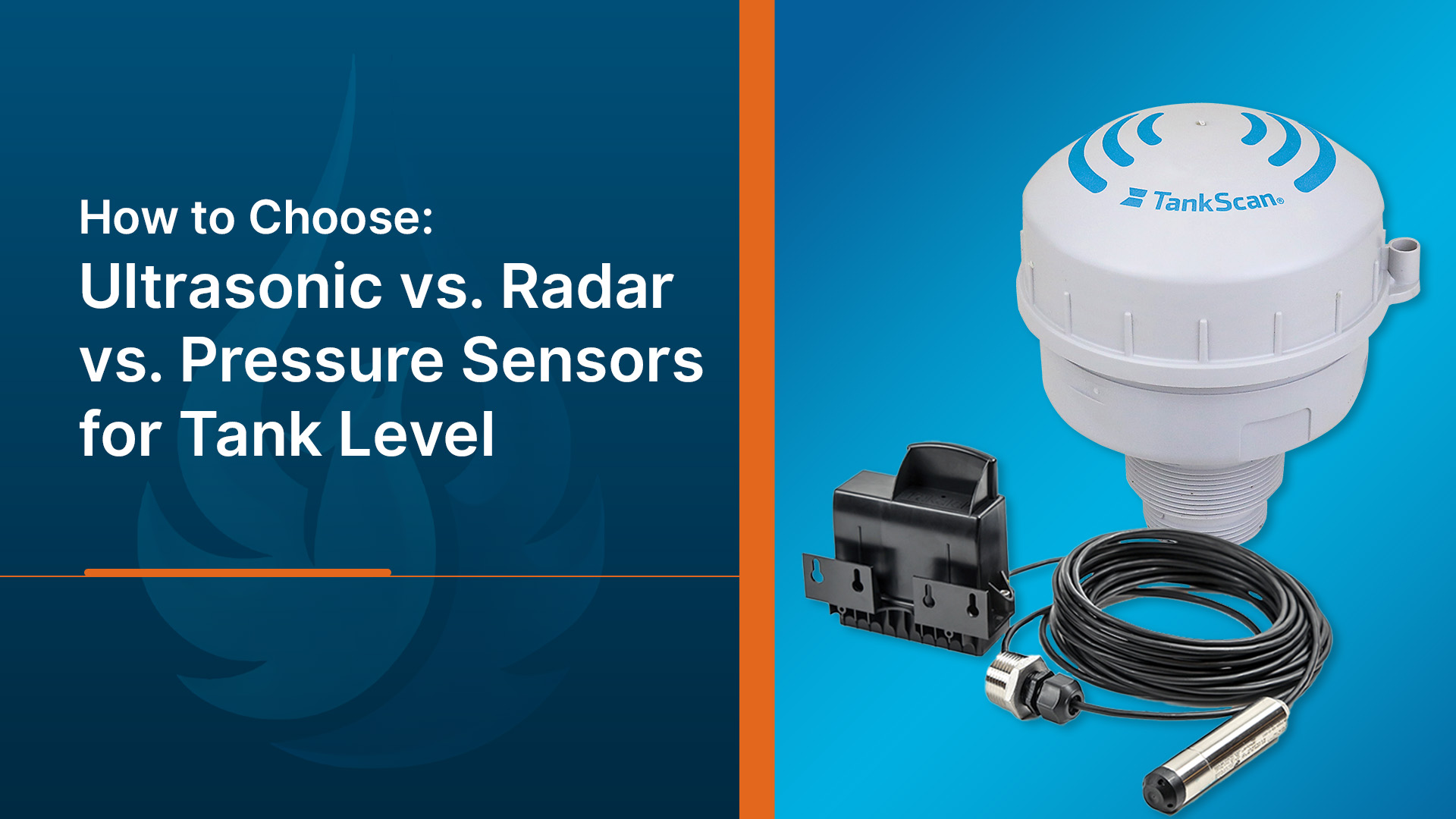
Accurate tank level measurement is the foundation of safe industrial water treatment. Miscalculating by only a few inches can result in wasted chemicals, equipment damage or serious safety risks.
While manual checks can be cost-effective, they’re prone to human error and inconsistent results. Investing in measurement technology protects your operations, optimizes resource use, reduces downtime and maintains compliance with safety standards.
The Importance of Tank Sensors
Tank sensors measure essential data for industries like chemical storage, feed or neutralization systems. Inaccuracies can lead to costly mistakes, including wasted products and unplanned downtime. Precise measurements ensure consistency, while protecting your budget and ensuring regulatory compliance.
On top of additional expenses and runtime, level accuracy directly affects efficiency and worker safety. Manual checks require workers to climb ladders and work around corrosive fluids. Eliminate these hazards with sensors that provide real-time, remote readings. With accurate and consistent data, facilities experience improved inventory management and reduced site incidents.
Common Level-Measurement Challenges in Water Treatment
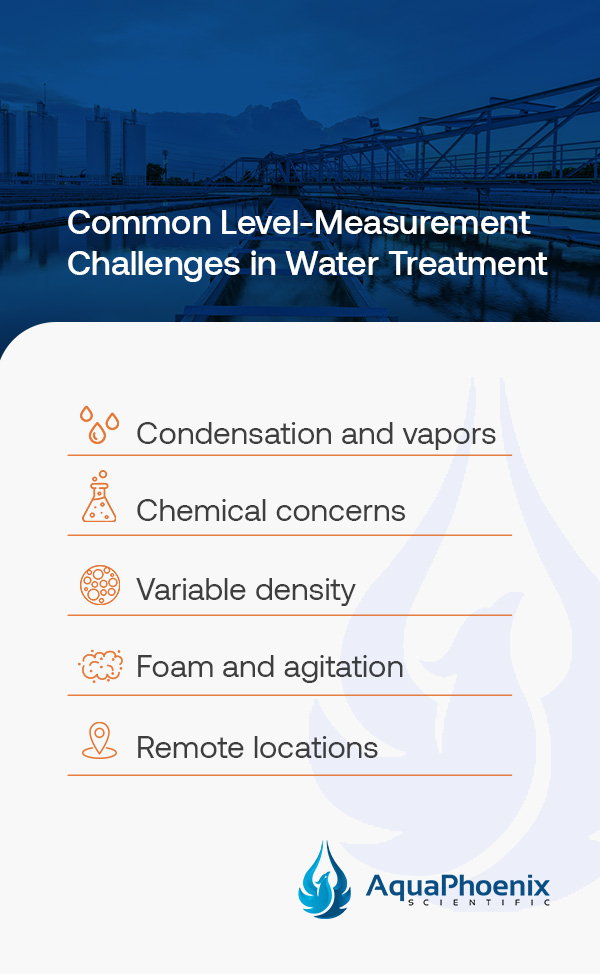
Industrial water treatment systems deal with demanding conditions daily. Changing temperatures or chemical vapor exposure complicates measuring tank levels. Understanding these challenges helps you choose quality sensors.
- Condensation and vapors: Tanks often emit vapor, especially those with acids or caustic chemicals. This vapor condenses onto surfaces, impacting sensor readings and making them less accurate. More condensation equals extra maintenance and calibration.
- Chemical concerns: Many contact sensors perform well in clean water or mild chemical environments, but continuous contact with process fluids leads to corrosion. Compounds like sodium hypochlorite can attack metal diaphragms and seals, leading to failure.
- Variable density: Chemical dosing tanks may contain solutions that change density when mixed or diluted. Contact sensors become inaccurate if the density changes. Operators must recalibrate frequently or apply density compensation factors to ensure accurate results.
- Foam and agitation: Surfactants or aerated wastewater frequently produce foam. Ultrasonic sensor waves reflect off this agitation, resulting in incorrect levels. Facilities must use devices that are unaffected by agitated liquid.
- Remote locations: Relying on manual inspections or wired sensors at each location of a multisite water treatment system increases labor and travel costs. Wireless transmitters are essential for enhancing visibility across all locations.
Understanding Non-Contact Level Measurement
Non-contact sensors are some of the most widely used tools for monitoring tank levels in industrial water treatment. In contrast to submersible or hydrostatic sensors, which directly contact the liquid, non-contact devices use sound or electromagnetic waves to detect fluid levels from above the surface. This design eliminates contamination risks, corrosion and frequent sensor maintenance.
Ultrasonic and radar are types of non-contact sensors that determine the level by emitting a wave signal. Then, they time the signal’s reflection from the liquid and convert that travel time into a distance measurement.
How Ultrasonic Sensors Work
Ultrasonic sensors emit short bursts of high-frequency sound waves toward the liquid surface. The waves travel, bounce off the liquid and reflect to the sensor. The time it takes for the echo to return minus the speed of sound gives the device the liquid level.
Since ultrasonic measurement relies on sound waves traveling through air, it performs optimally in stable, well-controlled environments. Use it for measuring water and non-corrosive fluids in clean, still and obstruction-free plastic or fiberglass tanks.
Ultrasonic sensors are a low-cost, easy-to-install choice. They provide continuous data without physically contacting the liquid, so they’re ideal for tight spaces and monitoring water in stable environments.
However, since ultrasonic sensors use sound, they can lose accuracy when they encounter:
- Turbulence
- Dust
- Temperature changes
- High humidity
- Foam
- Condensation or vapor
- Wind and other noises
- Obstructions
How Radar Sensors Work
Radar sensors use microwave energy instead of sound for measurement. The sensor emits electromagnetic waves toward the liquid’s surface. These waves reflect to the transmitter, and you can use the return to calculate the distance to the liquid surface. Microwaves travel at a relatively constant speed, even in slightly varying air density conditions. They’re incredibly accurate in almost any environment.
There are two primary radar sensor designs.
- Non-contact radar sensors mount above the tank and send free-speed microwave pulses toward the surface. Use them for corrosive, viscous or hazardous fluids.
- Guided wave radar sensors transmit microwaves along a probe or cable that extends into the liquid, creating a more stable signal in turbulent or narrow vessels.
Radar sensors are precise, reliable and perform consistently, even when vapor or pressure changes interfere with other measurement tools. Changes in the dielectric properties of most process materials do not affect them. Their readings remain accurate even in different liquid compositions or temperatures. Use radar sensors for chemical storage tanks, corrosive fluids, pressurized vessels and outdoor installations. Radar can even measure through plastic and fiberglass.
The primary drawback is the higher up-front cost of radar compared to ultrasonic models. Some even require calibration for proper readings in complex tank geometries. However, modern radar designs make this technology much more accessible for water treatment and chemical applications.
Exploring Contact-Based Measurement
Contact-based sensors are another trusted option for tank monitoring. These sensors sit directly in the liquid, measuring hydrostatic pressure to determine fluid level. Contact-based sensors rely on physical immersion, so surface conditions don’t affect them.
Contact-based devices are stable and cost-effective in the appropriate setting. Choose them for underground tanks or wastewater pits where vapor is a concern. However, their constant fluid exposure means contact-based devices need materials and housings compatible with the liquid in the tank.
Hydrostatic pressure sensors are the most common contact technology. They convert the pressure exerted by the liquid above them into electrical signals. As the tank fills, the pressure reading increases, and vice versa. Facilities get a continuous level measurement that they can integrate into their monitoring systems.
How Hydrostatic Pressure Sensors Work
Hydrostatic pressure sensors operate using pressure. The pressure at a specific depth in a liquid tank is directly proportional to the liquid’s height and density. The sensor sits at the bottom of the tank, where it measures pressure using a diaphragm or a strain gauge. A calibration factor based on fluid density converts the electrical signal into a level reading.
Contact sensors are excellent for aerated or agitated tanks. At the tank bottom, there’s no interference from foam or turbulence. They’re also cost-effective and simple to install. It’s an ideal solution for permanent installations in smaller or enclosed tanks.
Contact sensors are always in direct contact with the process fluid, so they require additional maintenance to remove the corrosion and scaling that can develop over time. Additionally, the sensor is only accurate if the liquid density remains consistent. Changes due to temperature or sediment buildup can impact readings. Facilities must regularly clean and calibrate to maintain accurate readings.
How to Select Your Tank Sensor
First, assess your specific circumstances. What tank type are you monitoring? What are the internal and external conditions? Ultrasonic, radar and hydrostatic sensors are all suitable for different environments. Here’s how to select the best option.
1. Identify Liquid Type and Properties
Your liquid’s composition and behavior are the first factors to consider when selecting a sensor. Chemical compatibility determines whether a contact-based sensor will corrode. Viscous, foam-forming and vapor-forming liquids will interfere with ultrasonic readings.
Radar sensors are the most versatile across liquid conditions. They rely on microwave signals instead of sound or contact, so they easily penetrate vapor, steam and foam. They can even tolerate corrosive atmospheres more easily. If your facility handles acids, caustics or chemical blends, radar provides the measurement accuracy and sensor performance you need.
2. Consider Tank Characteristics
Tank size, shape and material also affect sensor performance. Ultrasonic sensors need an unobstructed path between the transducer and the liquid surface. They’re less effective in narrow tanks or containers with baffles and mixers. Pressure sensors require full submersion and might need access through side ports or below the tank.
Radar sensors provide the most flexibility. You can mount non-contact radar devices at the top of almost any tank, regardless of height or configuration. Microwave signals can pass through nonconductive materials, so radar sensors can even measure through closed tank lids. This setup protects the sensor from splashing fluids or corrosive fumes, so they’re especially valuable for sealed chemical or reagent tanks.
3. Record Environmental Conditions
External conditions will also affect sensor reading reliability. Extreme temperatures, condensation, humidity and airborne dust can all degrade ultrasonic performance and damage exposed components. Sound waves slow and scatter in high-pressure or outdoor spaces, which impacts reading accuracy.
Outdoor conditions are less likely to affect contact sensors. However, changes to liquid density can affect their results. They need regular calibration and cleaning for best results. Radar sensors are largely immune to environmental conditions that affect ultrasonic devices. Electromagnetic signals maintain accuracy in conditions like high humidity or freezing weather. They’re the most consistent option for outdoor tanks or chemical storage yards.
4. Establish Accuracy Needed
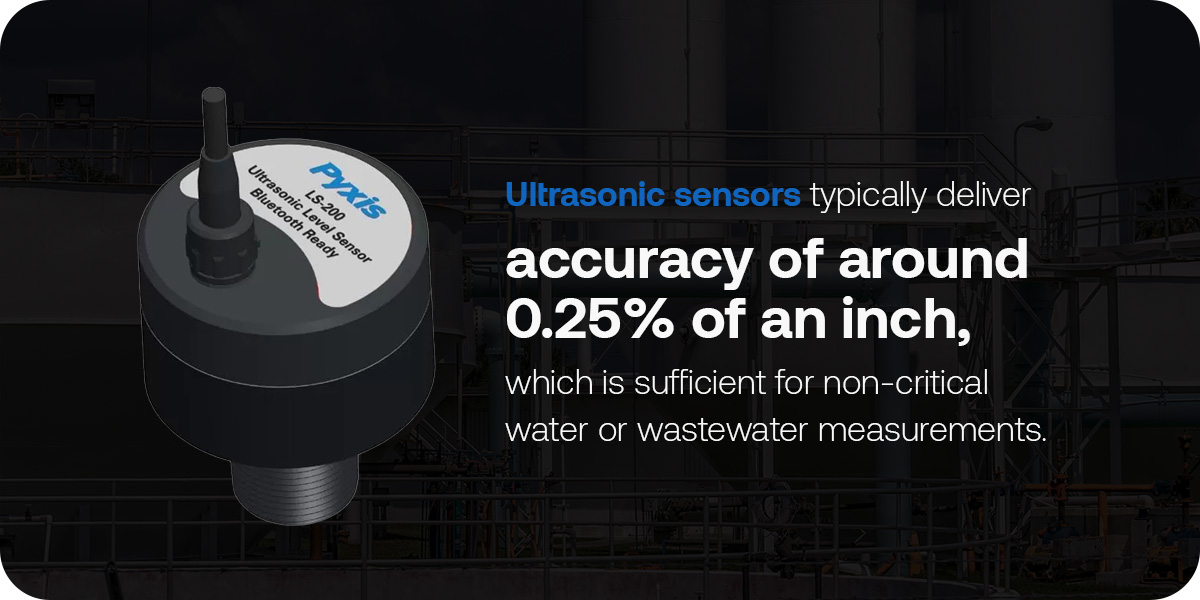
The precision and accuracy needed for your application determine which technology provides the most value. Ultrasonic sensors typically deliver accuracy of around 0.25% of an inch, which is sufficient for non-critical water or wastewater measurements. Hydrostatic pressure sensors generally achieve approximately 0.1% of full scale, though this value can drift due to changes in liquid density.
Radar sensors set the standard for precision. They offer millimeter-level accuracy in most configurations. This level of accuracy is essential if you’re dealing with automated chemical dosing or compliance monitoring. Radar sensors even offer this accuracy across temperature and pressure variations. They offer the most dependable data for high-value or safety-critical systems.
5. Compare Maintenance and Lifespan
Every level sensor has mechanical and environmental limits. Over time, wear and buildup can affect performance. A sensor that costs less up front may cost more in long-term maintenance and replacement fees.
While ultrasonic sensors are simple, convenient to install and affordable, they need frequent cleaning and inspection. If your facility sees constant vapor and chemical residue, teams will need to wipe down ultrasonic sensors regularly. Internal components will degrade with prolonged exposure to humidity or corrosive fumes. Ultrasonic devices last the longest in clean-water applications.
Hydrostatic pressure sensors will operate for long periods with minimal attention, but only when they’re compatible with fluid chemistry. Continuous contact with aggressive chemicals can wear down the sensor components. Inspect them regularly and recalibrate periodically to extend lifespan and avoid level drift.
Radar sensors have the longest lifespan and require the least maintenance. They never touch the process liquid, and air contamination doesn’t affect their signal. There’s little to clean or adjust after installation. Maintenance involves checking mounting integrity and confirming that electronics are moisture-free. Their solid-state design has no moving parts, and they can handle years of continuous indoor and outdoor operation.
A Smarter Solution for Industrial Water Treatment
Traditional tank monitoring often depends on manual inspections to check fluid levels. These methods are time-consuming and usually less accurate. They also expose your workers to unnecessary risks, especially when working with corrosive chemicals. Manual checks can’t keep up with modern operations’ demanding accuracy and safety needs.
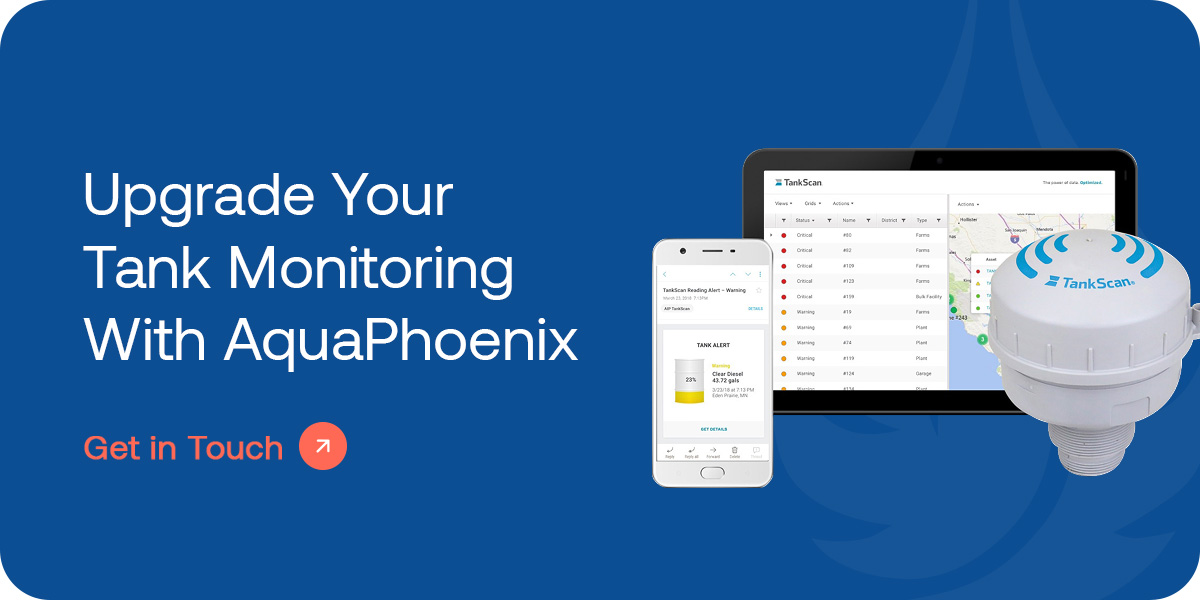
AquaPhoenix’s TankScan® wireless monitoring system redefines efficiency. TankScan combines advanced radar-level sensing with remote data access. Operators gain real-time visibility into every tank across all sites. Its non-contact radar technology ensures accurate measurements, even in the most challenging conditions.
Users who integrate TankScan with AquaPhoenix’s monitoring platform can view live tank data from any device, receive automated alerts and optimize chemical deliveries based on actual usage.
Upgrade Your Tank Monitoring With AquaPhoenix
Ultrasonic sensors are a cost-effective starting point, while pressure sensors are practical for simple systems. However, radar technology delivers the accuracy, durability and flexibility industrial water treatment demands.
AquaPhoenix brings that performance to your operation with TankScan radar sensors. Get the accuracy and precision you need while accessing remote monitoring and data-driven insights. TankScan integrates seamlessly with AquaPhoenix’s platform to support predictive maintenance and improved chemical inventory control.
Simplify tank monitoring. Contact AquaPhoenix to discuss your needs or explore our products online.