As global food distribution becomes increasingly complex and consumers demand more from their purchases, packaging should do much more than make products look attractive on store shelves. Today’s producers must design solutions that guard against damage, spoilage and tampering while also addressing sustainability, branding and traceability.
Achieving these goals requires more than innovative materials or eye-catching designs — it demands a commitment to rigorous testing and continual quality checks. Behind every successful food product is a packaging process rooted in careful evaluation, thoughtful material selection and thorough validation. This overview explores how comprehensive testing protocols ensure packaging serves its critical role.
Why Testing in Food Packing Matters
Modern food packaging fulfills two primary functions. It attracts consumers with appealing designs and informative labels while serving as the first line of defense against internal and external threats.
- Ensuring consumer safety by preventing contamination: Every year, food recalls due to contamination affect millions of consumers. Packaging is a barrier against contaminants, and proper testing ensures harmful chemicals from inks and adhesives do not leach into food. Scientifically validated testing can directly address risks such as microbial ingress, physical breaches and toxic leaching.
- Protecting brand reputation and avoiding costly recalls: Food recalls are expensive and can cause irreparable brand damage. Recalls often result in broken public trust, leading current consumers to turn away and dissuading potential consumers from trying new products. Testing significantly reduces the likelihood of packaging failures that result in unsafe products reaching the market, safeguarding public trust and your bottom line.
- Meeting complex national and international standards: Regulatory agencies worldwide enforce stringent packaging regulations. Regulatory agencies like the U.S. Food and Drug Administration and the European Food Safety Authority require organizations to meet compliance standards. Testing demonstrates this compliance with things like migration limits, labeling laws and material traceability to facilitate domestic and global exports.
- Verifying and extending product shelf life to prevent waste: Food waste is a significant global concern. Experts estimate nearly 1 billion meals a day end up lost or wasted. Improper testing or a lack of quality packaging contribute to food waste by increasing the likelihood of contamination and spoilage. Proper packaging can keep out moisture and oxygen, block UV light and keep food environments stable to ensure accurate shelf-life claims.
An Overview of Testing in the Food Packaging Industry
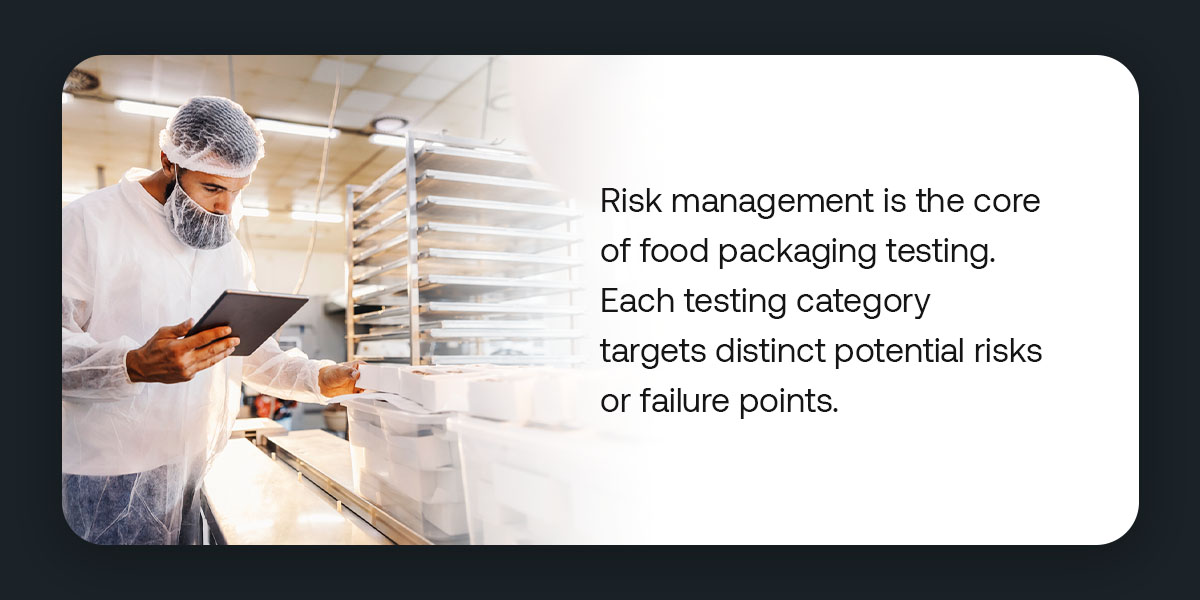
Risk management is the core of food packaging testing. Everything from raw materials to final, assembled packages must meet specific standards to pass regulatory scrutiny and meet consumer expectations. Each testing category targets distinct potential risks or failure points.
Material Safety and Migration Testing
A significant concern is the potential for chemicals to migrate from the packaging into the food. For example, residual monomers from plastics, inks from labels or plasticizers from sealants can contaminate food products. Testing for these elements involves several options.
- Gas chromatography: GC testing screens for intentionally added substances, such as adhesives, antioxidants and plasticizers. It can also identify non-intentionally added substances, especially when working with additional testing methods.
- Gas chromatography-mass spectrometry: GC-MS is highly sensitive, making it ideal for detecting various pesticide residues at trace concentrations. It can also quantify compounds like alkylphenols, styrene, bisphenols, phthalates and other volatile compounds that migrate from packaging to food.
- Liquid chromatography: LC tests analyze larger, less volatile compounds. Specific LC methods can assess the migration of additives, dyes or oligomers.
- Migration testing: Migration tests check for chemical leaching from packaging substances into food. This testing is pivotal because chemical migration can affect food safety, taste and integrity. Testing can be more specific, depending on the material you use.
Physical and Mechanical Strength Tests
Containers must endure various physical challenges throughout their life cycles. Food products undergo filling operations, transportation, retail display and consumer use. Physical and mechanical strength tests assess durability to ensure packaging can meet the demands of each environment.
- Puncture resistance: This test determines the packaging’s ability to withstand penetration from sharp objects, which is critical for avoiding breaches during shipping.
- Drop tests: These testing methods simulate accidental falls during production or distribution to assess whether the package can withstand the impact without rupturing.
- Compression strength: Stacked items must undergo compression testing to evaluate how much weight a package can bear before deforming or failing.
- Tensile and tear testing: These methods measure the force required to pull the packaging material apart or initiate a tear, indicating resilience during handling and storage.
Barrier Property Analysis to Prevent Spoilage
Effective packaging is a barrier that preserves food quality by blocking undesirable elements. Barrier property analysis assesses a package’s ability to perform this duty. This analysis occurs in specialized chambers that simulate real-world storage environments.
- Oxygen transmission rate: OTR indicates how much oxygen permeates the packaging over time. This measurement is crucial for products prone to oxidation, such as oils and snacks.
- Moisture vapor transmission rate: MVTR measures the rate at which moisture passes through a package. For hygroscopic foods, such as salt, grains and crisp foods, maintaining low MTCR is essential to shelf life.
- Light transmission: Sensitive foods like fruits and vegetables degrade in quality when exposed to bright light. Light transmission measurements ensure packaging can block or filter damaging wavelengths.
Seal Integrity and Leak Detection
Regardless of material durability, packaging with defective seals compromises food integrity. Seals must be tight enough to prevent liquid, air and bacteria ingress while allowing for consumer-friendly opening. Fundamental testing techniques include the following.
- Vacuum method ASTM D3078: The vacuum method involves placing the packaging underwater. As a chamber vacuum pulls external pressure down, air escapes through leaks and creates bubbles. This test is best for flexible packaging, such as packaging for dairy pouches, snacks or pet treats.
- Internal pressurization ASTM F2096: This testing method introduces air inside the submerged packaging. If a defect is present, air will escape as bubbles. Vacuum-sealed products benefit from this test method.
- Altitude simulation ASTM D6653: Products that travel through changing elevations, such as packages moving by air, should undergo altitude simulations. This test simulates pressure changes, revealing film stress points or package weakness in low pressure.
- Dry chamber testing ASTM D5094: This method uses sensors to detect pressure changes resulting from leaks. Liquid-fill containers often rely on this technique.
How to Test Packaging Materials
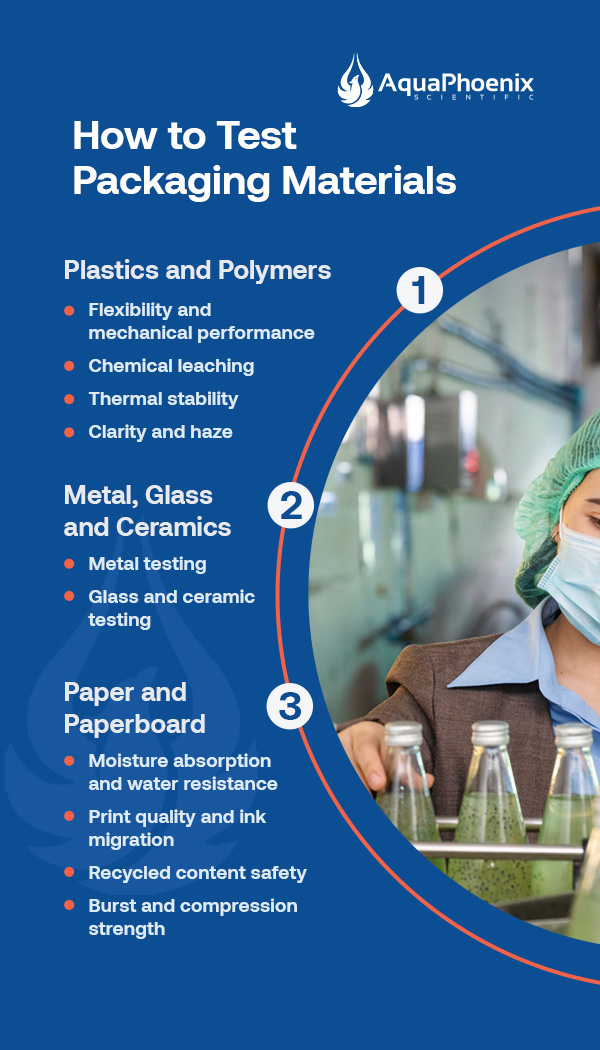
The food packaging industry uses various materials with unique characteristics, risks and regulatory considerations. Tailoring testing methods according to material type ensures they meet stringent quality and safety requirements.
1. Plastics and Polymers
Plastics dominate modern food packaging due to their versatility, lightweight nature and cost-effectiveness. However, safety concerns like chemical migration are paramount. Testing for plastics and polymers should assess multiple facets.
- Flexibility and mechanical performance: Measure tensile strength, tear resistance, elongation and impact resistance. Essential tests to assess these elements often take place at various temperatures to replicate cold-chain logistics and hot-fill processes.
- Chemical leaching: Regulatory limits set strict thresholds for chemical leaching. Migration testing focuses on additives, monomers and plasticizers and should take place at elevated temperatures
- Thermal stability: This testing ensures a material can maintain integrity and does not release harmful chemicals under heat exposure. Microwaveable containers must exhibit thermal stability.
- Clarity and haze: You must assess transparent packaging, such as bottles and wraps, for optical properties. Haze meters can detect cloudiness or imperfections that could result in diminished product quality.
2. Metal, Glass and Ceramics
Metals, glass and ceramics are favorite materials because they have exceptional barrier properties and immense durability. However, these materials have unique testing requirements.
- Metal testing: Metal testing assess structural integrity, corrosion resistance and the presence of coatings or linings. Compression, tensile and impact tests ensure the material won’t buckle, crack or dent during logistics. Corrosion testing leverages simulated environment exposures to assess corrosion susceptibility. Coatings or linings present on the metals should undergo testing for curing, residual migration and adhesion.
- Glass and ceramic testing: Glass and ceramics must undergo thermal shock, impact resistance and lead and heavy metal testing. Thermal shock testing assesses how well containers can handle rapid shifts between hot and cold, which is critical for processes like canning. Impact resistance tests, such as drop and ball tests, evaluate the ability to withstand handling accidents. Lead and heavy metal testing is essential for packaging with glazes and paints used in decorative finishes to ensure no toxic elements migrate into food.
3. Paper and Paperboard
Despite the shift toward plastics and metals, paper and paperboard remain essential for dry foods, frozen products and secondary packaging.
- Moisture absorption and water resistance: These tests measure how much water a material absorbs over a set period. This method is ideal for packaging that may encounter humidity or condensation.
- Print quality and ink migration: These migration tests evaluate whether printed materials bleed, fade or transfer onto food. These tests can also assess the migration of chemicals from printing inks.
- Recycled content safety: Paperboard with recycled content undergoes screening for residual mineral oils, chemicals and contaminants. These test methods typically include GC and GC-MS.
- Burst and compression strength: These tests ensure structural durability for stacking and transport.
Water Quality in Packaging Operations
Water is an underappreciated but critical player in any discussion of food packaging safety and quality. Its influence reaches far beyond cleaning to affect every aspect of sanitation, ingredient testing and package manufacturing. Overlooking water quality at any stage of the packaging life cycle can jeopardize food safety, undermine quality control and compromise regulatory compliance.
Cleaning and Sterilization
Water is a universal cleaning agent in packaging plants. Equipment, surfaces and sometimes even the packaging materials undergo sanitization using water to remove dust, residues, adhesives or microbes that could compromise product quality. If water contains bacteria, fungi or chemical contaminants such as heavy metals or chlorinated by-products, these can migrate onto packaging surfaces, potentially leading to cross-contamination of food downstream.
For high-risk foods, such as ready-to-eat items, packaging often receives sterilization prior to filling. Techniques might use hot water, steam or water-based chemical sanitizers, all of which must be free of impurities. Waterborne contaminants could lead to spoilage, altered product characteristics or increased pathogen presence in packaged food.
Package Manufacturing
Teams often use water to process paper and paperboard packaging, in cooling systems for plastics and for applying adhesives and coatings. Impurities in process water can cause visible packaging defects, such as streaks, spotting and discoloration, interfere with adhesion or leave behind chemical residues that interact with food. In advanced polymer manufacturing, trace ions or organic matter in water can disrupt the precision necessary for specialty food-grade materials.
Testing Laboratories
Analytical laboratories depend on water of the highest purity. Any migration, residual or microbial test for packaging must use water that does not contribute to contamination in analytical readings. For instance, laboratory-grade water is essential for creating standard solutions, rinsing glassware, diluting reagents and directing sample extraction processes.
Water quality issues in lab testing can manifest in subtle and costly ways. For example, trace metals present in the analysis water can lead to false positives in heavy metal testing for packaging. Organic contaminants can also cause mass spectrometry “ghost peaks.” Even seemingly innocuous minerals like calcium or chlorine can interfere with migration testing by reacting with food simulants or test reagents.
Water Quality Parameters and Monitoring
Water is typically subject to strict monitoring regulations to ensure it is fit to use. Water testing parameters include:
- Microbial load, measured by total plate count or coliform testing
- Chemical content, including pH, conductivity and total dissolved solids
- Absence of specific impurities, such as heavy metals or volatile organic compounds
Packaging plants and laboratories often install water treatment systems ranging from filtration and reverse osmosis to ultraviolet or ozone sterilization. These require regular maintenance and validation. Documented water quality logs and periodic third-party testing ensure you can reliably meet all critical limits and regulatory requirements.
The Impact on Product Quality and Regulatory Compliance
Subpar water quality can also ripple throughout the packaging process, affecting the accuracy of regulatory compliance checks and product shelf life. If waterborne contaminants compromise packaging tests, invalid data may require costly retesting, potentially leading to noncompliance findings during regulatory inspections.
In summary, water quality control is integral to ensuring the safety, consistency and compliance of every packaging operation. Leading manufacturers and laboratories treat water as an operational utility and as a core ingredient in delivering packaging solutions that consumers and regulators can truly trust.
Partnering for Packaging Peace of Mind
Food packaging exists at the intersection of consumer safety, regulatory compliance and technological innovation. Rigorous testing ensures packaging fulfills its responsibilities as a physical and biological shield. However, poor water quality can compromise the most advanced packaging systems. From sanitation and sterilization to laboratory testing, water purity directly impacts reliability and results.
AquaPhoenix Scientific is a leading provider of the necessary water testing tools to ensure integrity and compliance. Our food and beverage test kits are suitable for all applications, from wastewater to sanitation. With our industry-proven solutions, you can confidently monitor water quality, uphold stringent safety protocols and support the full life cycle of your food packaging operation. Request a quote to discover how we can aid your operations.