The bottling industry operates behind the scenes of nearly every product we enjoy, from spring water and juices to pharmaceuticals and personal care items. Yet, most consumers rarely consider the amount of science, engineering and quality control that goes into ensuring every bottle is fit for purpose.
With rising consumer expectations, evolving health and safety regulations and the constant push for sustainable practices, the demands on bottle design and testing have never been higher. Quality assurance teams must balance compliance and innovation, all while minimizing the risk of costly failures. Each container must pass an array of tests and analyses before its journey even begins.
This guide dives into the principles of bottle testing, exploring why it matters, the risks it mitigates and the specialized tests that define container quality today. Whether you’re overseeing production, designing packaging or ensuring regulatory compliance, understanding bottle testing is key to delivering products that stand up to real-world demands.
The Role of Testing in the Bottling Industry
Before a bottle reaches a store shelf or a customer’s hand, it must withstand a range of rigorous tests. These testing protocols are essential for maintaining operational efficiency, meeting customer demands and supporting brand excellence.
Testing standards continuously evolve. Understanding the scope and purpose of container testing is fundamental for anyone involved in the production, distribution or oversight of packaged goods. The risks of inadequate container quality are high, including:
- Product spoilage and contamination: The primary function of any bottle is to protect what’s inside. Leaks from molding defects, insecure closures or improper seals can introduce external contaminants, rendering the product unsafe or spoiling the contents. Worse, chemical leaching can result in compounds migrating from the container’s material into the product, undermining quality and safety. These issues can destroy entire batches.
- Brand reputation damage: A single instance of product leakage or breakage can create negative publicity and erode consumer trust. Customers expect bottled goods to arrive intact and fresh, so they can enjoy the products they purchase with peace of mind. When containers fail, whether through cracks, bursts or faulty seals, companies may have to address complaints and initiate recalls.
- Regulatory and compliance failures: The bottling industry operates under stringent safety and quality standards. Governing bodies, like the International Organization for Standardization and American Society for Testing and Materials, set strict packaging and performance benchmarks. Regulatory compliance is mandatory. Failing to adhere to standards can result in hefty fines, product recalls, legal actions or failed market entry.
- Supply chain and profit loss: Every supply chain is vulnerable to container weaknesses. For example, bottles with low top-load strength may collapse under the weight of stacking during storage or transit, leading to breakages, leaks and product waste. These failures drive up costs by causing reworks and delivery disruptions.

Key Physical Performance Tests for Bottles
Manufacturers use a suite of physical performance tests to mitigate risks and ensure quality. Each test aims to simulate the real-world stresses that bottles encounter as they transition from factory to consumer.
Structural Integrity and Durability
Bottles serve as protective barriers, but their performance is only as strong as their physical designs and construction. To guarantee that containers can reliably withstand the demands of real-world use, manufacturers rely on several mechanical evaluations.
These assessments aim to address everyday bottle hazards. They also allow manufacturers to understand bottle limitations to predict and prevent container failures.
Key structural integrity and durability tests include:
- Top-load testing: Top-load testing evaluates a bottle’s capacity to withstand vertical pressure. This test ensures bottles remain structurally sound even at the base of a fully loaded pallet. Insufficient top-load strength can cause container collapse, damaging the original bottle and the surrounding products and packaging.
- Burst and creep testing: Burst testing measures a bottle’s ability to endure elevated internal pressure, which is crucial for carbonated beverages or hot-filled products. In this test, the bottle is pressurized until it fails, determining the maximum burst threshold. Alternatively, creep testing examines how containers perform under sustained pressure over time. This test identifies slow deformation or failures, which help manufacturers anticipate problems during long-term product storage.
- Drop impact analysis: Drop tests simulate the shocks and impacts bottles may experience during packing, shipping or everyday handling. By dropping bottles from predetermined heights and positions, manufacturers can identify and rectify weaknesses. Sensors can be incorporated to measure the force of impact. Analyzing the resulting damage, from minor dents to complete rupture, helps manufacturers refine their designs and select more resilient materials.
- Wall thickness and distribution: Uniform wall thickness is an indicator of bottle quality. Areas with thin, uneven walls are natural weak points. Using specialized equipment, manufacturers can measure and map wall thickness throughout the container. This process aims to prevent unexpected breakage, especially in high-stress areas, such as the bottle base or neck.
Closure and Seal Integrity
A bottle is only as good as its seal. Even a perfectly formed container can fail if the closure doesn’t perform. The interaction between the container and its closure is crucial for maintaining product integrity, particularly during handling, transportation and storage.
Ensuring a dependable seal requires careful attention to both engineering and quality control. Closures must strike a balance between security and usability, preventing leaks while remaining user-friendly. Through targeted seal and cap performance testing, manufacturers can minimize the risk of contamination or spoilage.
- Secure seal and torque testing: This test evaluates both the application and removal torques of bottle caps or closures. The goal is a closure that’s tight enough to preserve freshness and prevent leaks, but not so tight that consumers struggle to open it. Consistent torque measurements ensure each bottle delivers the same experience.
- Vacuum and leak decay testing: Airtight seals are essential for preventing product contamination and spoilage, especially for perishable goods. Vacuum and leak decay testing involves creating a vacuum around the closure or applying pressure within the bottle. Results indicate any gradual loss of pressure or vacuum. These tests confirm that the closure system effectively prevents external air and microbes from entering the bottle.

Chemical and Barrier Property Analysis
Beyond mechanical strength, bottle materials must maintain purity and serve as effective barriers to external elements. At the molecular level, the effectiveness of a bottle depends on how it responds to surrounding chemicals, gases and moisture.
Sophisticated testing helps teams understand these interactions and validate that the chosen materials consistently meet performance expectations. By examining both chemical compatibility and barrier capabilities, manufacturers can confidently deliver products that stay fresh, safe and stable throughout their intended life cycle.
Material Safety and Composition
The material of the bottle is as important as the physical qualities. The chemical composition of packaging materials has a direct impact on product purity, consumer safety and regulatory compliance. As manufacturers seek performance and sustainability, understanding and controlling the ingredients and properties of container materials is more important than ever.
Material analysis confirms that bottles are built from the right substances and helps detect potential issues before they reach consumers.
- Migration and leachability testing: Migration testing determines whether any chemicals from the container can transfer into the contents. This test is especially relevant for plastic containers or those with coatings. Strict regulations, such as the Food and Drug Administration (FDA) standards for food-contact materials, govern these limits. Testing replicates worst-case scenarios, such as high temperatures or extended storage, to guarantee the bottle’s material is safe for intended use.
- Material identification: Material identification techniques, like Fourier-transform infrared spectroscopy (FTIR), verify that bottles are made from the specified and approved resins. Incorrect material grades can compromise safety, functionality or recycling compatibility. FTIR testing ensures each batch meets the manufacturer’s specification.
Barrier Performance Testing
Even trace amounts of air or moisture can compromise product flavor, nutrition, shelf life or safety. Advanced packaging creates a barrier that preserves quality and longevity. Barrier performance testing provides essential insights into this protective function. Products reach consumers exactly as intended, without unwanted changes or contamination.
Testing methods include:
- Oxygen and CO2 transmission: Some products, such as juice or beer, are highly sensitive to oxygen or need to retain carbonation. Oxygen transmission rate (OTR) and carbon dioxide transmission rate (COTR) testing measure how effectively the bottle can block these gases. Low OTR and COTR values indicate bottles that maintain product freshness and taste, while higher rates can lead to premature spoilage or reduced quality.
- Water vapor transmission (WVTR): WVTR testing assesses a bottle’s resistance to moisture transfer. Measuring and minimizing WVTR is critical for a wide range of product types. For dry products, high WVTR can allow humidity to spoil contents. For liquids, it may cause the product to lose volume or concentration over time.
Bottle Testing vs. Water Testing: A Complete Quality Strategy
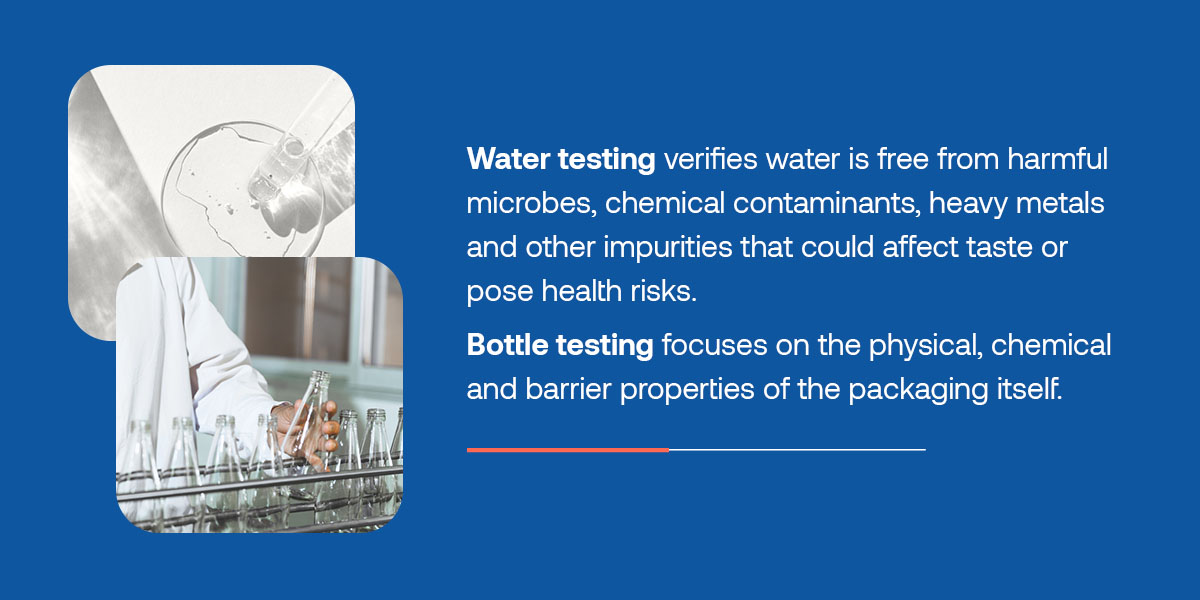
Water testing verifies water is free from harmful microbes, chemical contaminants, heavy metals and other impurities that could affect taste or pose health risks. Regulatory agencies around the globe, including the U.S. Environmental Protection Agency and the FDA, set standards to ensure bottled water and other beverages are consistently safe and high-quality. As a result, water testing is a core requirement for compliance and consumer trust.
However, even the cleanest, purest water can become compromised if the bottle that contains it isn’t equally reliable. This is where container or bottle testing comes into play. Bottle testing focuses on the physical, chemical and barrier properties of the packaging itself. It addresses crucial questions:
- Will the bottle protect its contents from outside contamination?
- Can it withstand the pressures and stresses of transportation and storage?
- Could any components migrate from the bottle material into the product?
These questions are central to preventing product spoilage, leakage or the introduction of unwanted substances.
Failures in bottle quality, whether through leaks, loss of carbonation, chemical migration or seal integrity, can cause product recalls, negative publicity and lost customer loyalty. Conversely, even a perfectly manufactured bottle can’t save a product if there are issues with the water inside. The two branches of quality control must work hand in hand to ensure the consumer receives a safe, pure and satisfying product.
An effective quality assurance program for the bottling industry should incorporate both water testing and bottle testing as integral components. Water testing in the bottling industry examines microbial and chemical composition, taste, odor, and compliance with local and international standards. Bottle testing includes assessments of structural strength, closure integrity, barrier performance and chemical safety.
By dedicating equal attention to both water and bottle testing, manufacturers can prevent a wide range of quality and safety issues before they reach the consumer. This dual approach also opens the door to meaningful innovation. Manufacturers can introduce new materials or processes without compromising safety or regulatory compliance.
Build a Comprehensive Quality Program With AquaPhoenix
As the bottling industry evolves, maintaining the highest standards of container quality is a regulatory requirement and a competitive advantage. Comprehensive bottle testing helps manufacturers prevent costly failures, protect their brand reputation and ensure consumer safety at every stage. From verifying structural integrity and seal performance to assessing chemical compatibility and barrier properties, these tests are essential for delivering products that consistently meet both marketplace expectations and legal mandates.
However, implementing an effective quality program often requires customized solutions tailored to unique business needs. That’s where AquaPhoenix excels. AquaPhoenix offers end-to-end support with innovative test kits, custom packaging solutions and expert guidance designed specifically for the bottling sector.
Our services go beyond standard testing. We provide resources for research and development, inventory management, fulfillment and ongoing staff training to ensure your organization’s success. By partnering with us, companies gain access to personalized solutions that streamline testing, simplify compliance and support operational efficiency.
AquaPhoenix is your expert partner for a holistic quality assurance strategy. Develop a comprehensive testing strategy for your entire bottling process by contacting our team.