Smart water systems deliver real-time monitoring that optimizes use, catches issues quickly and provides predictive maintenance to reduce emergency repairs. Realizing these benefits requires a security strategy that protects the operational environment and all connected endpoints.
IoT security in water systems integrates secure connectivity, centralized data management and unified information technology and operational technology protocols into a defensible ecosystem.
This guide provides a strategic framework for architecting secure Internet of Things infrastructure for water management. You will learn how system-wide resilience unlocks operational efficiency, ensures regulatory compliance and supports sustainable growth.
Architecting a Defensible IoT Ecosystem for Water Management
Building robust IoT security in water systems requires embracing an architecture that protects operations at every level.
Device-Level Security to System-Wide Resilience
Many facilities approach IoT security by updating firmware, changing default passwords or installing patches on individual IoT devices. However, these measures only address part of the challenge, since cyberattacks exploit the weakest entry point and move laterally across systems.
A compromised device threatens:
- Supervisory control and data acquisition systems managing treatment processes
- Human-machine interfaces where operators monitor operations
- Programmable logic controllers executing automated sequences
- Communication networks connecting remote sites
System-wide resilience shifts focus from protecting components to defending the operational ecosystem. Water-treatment plants operate as interconnected environments where IoT devices, network infrastructure and data platforms must function as a unified security perimeter. When one element fails, cascading costs impact operations across the facility.
A resilient architecture withstands threats, detects anomalies quickly and recovers without disrupting water quality.
The Principles of a Holistic Security Strategy
Effective cybersecurity for critical infrastructure relies on layered defenses. Foundational principles guide this approach.
- Defense-in-depth: Multiple security layers distributed throughout the network spread protection across connectivity endpoints, application interfaces and data storage, so additional controls mitigate breaches at one layer.
- Zero-trust architecture: No device or user receives automatic trust. Every access request requires verification, and permissions follow least-privilege principles.
- Continuous monitoring: Overseeing network traffic, system logs and user behavior to enable rapid anomaly detection.
Layered security is essential to a defensible water system architecture, and federal agencies provide sector-specific guidance to help utilities strengthen their defenses.
Aligning With CISA and EPA Cybersecurity Performance Goals
Securing water infrastructure increasingly carries regulatory expectations. The Environmental Protection Agency and Cybersecurity and Infrastructure Security Agency establish benchmarks through the Cybersecurity Performance Goals framework, providing a government-backed roadmap with actionable security targets.
Recent EPA actions demonstrate the agency’s priority of protecting water systems from digital threats. For facilities planning IoT deployments, aligning with these goals reduces retrofitting costs and streamlines audits.
The American Water Works Association offers comprehensive cybersecurity guidance that translates federal goals into actionable frameworks. Their resources help teams map current infrastructure against benchmarks and identify gaps requiring attention.
IoT Security in Water Quality Management
A holistic security strategy rests on four technological pillars that work together to create an integrated defense.
1. Secure Connectivity
Network connections form the foundation of any IoT deployment. Unsecured devices communicating over the public internet create vulnerability. Managed cellular modems use private networks and VPNs to isolate traffic.
Secure connectivity solutions designed for industrial applications provide these capabilities while reducing the security burden on facility teams.
- Proactive firmware updates: Security patches deploy automatically without disrupting water quality monitoring or treatment operations at remote sites.
- Hidden VPN tunnels: Encrypted connections protect sensitive operational data about treatment processes, chemical dosing levels and water quality parameters from interception.
- Centralized monitoring: Administrators receive alerts for unusual traffic patterns that could signal compromised sensors or unauthorized access to treatment controls.
- Failover redundancy: Backup connectivity paths maintain continuous water quality monitoring and operational visibility even if primary communication links fail.
2. Centralized Data and Reporting
Your system must securely store tamperproof water quality data collected across your system for regulatory compliance. Centralized platforms consolidate treatment logs, water quality test results, chemical dosing records and operational alerts into a single environment that auditors can trust.
- Anomaly detection: Unauthorized changes to chlorine dosing setpoints, unexpected pump shutdowns or suspicious after-hours access to treatment controls trigger immediate alerts before they compromise water quality.
- Compliance reporting: Verified data sources automatically generate EPA-mandated water quality reports, Safe Drinking Water Act documentation and chemical use logs, eliminating manual transcription errors during audits.
- Unified visibility: Operators access real-time water quality readings, equipment status and historical treatment data through a single dashboard, responding quickly when parameters drift out of specification.
Water industry software platforms designed for treatment facilities maintain the chain of custody for water quality data while enabling regulatory reporting. Detecting unauthorized system changes early prevents compromised data from masking actual water quality issues.
3. Operational Technology OT Endpoints
Operational technology refers to hardware and software that directly monitor and control physical processes. In water management, OT endpoints include pumps, valves, flow meters, chemical dosing systems and controllers.
The distinction between IT and OT security matters because the failure modes differ. A compromised office computer might leak documents. An OT controller breach can alter chemical dosing levels or disable safety interlocks — creating immediate risks to water quality and public health.
Securing OT endpoints requires several safeguards.
- Network segmentation: Isolating these devices from less-critical systems limits attackers’ lateral movement.
- Change management: Updates or configuration modifications undergo testing before production deployment.
- Physical security: Restricting unauthorized access to control panels adds protection against tampering.
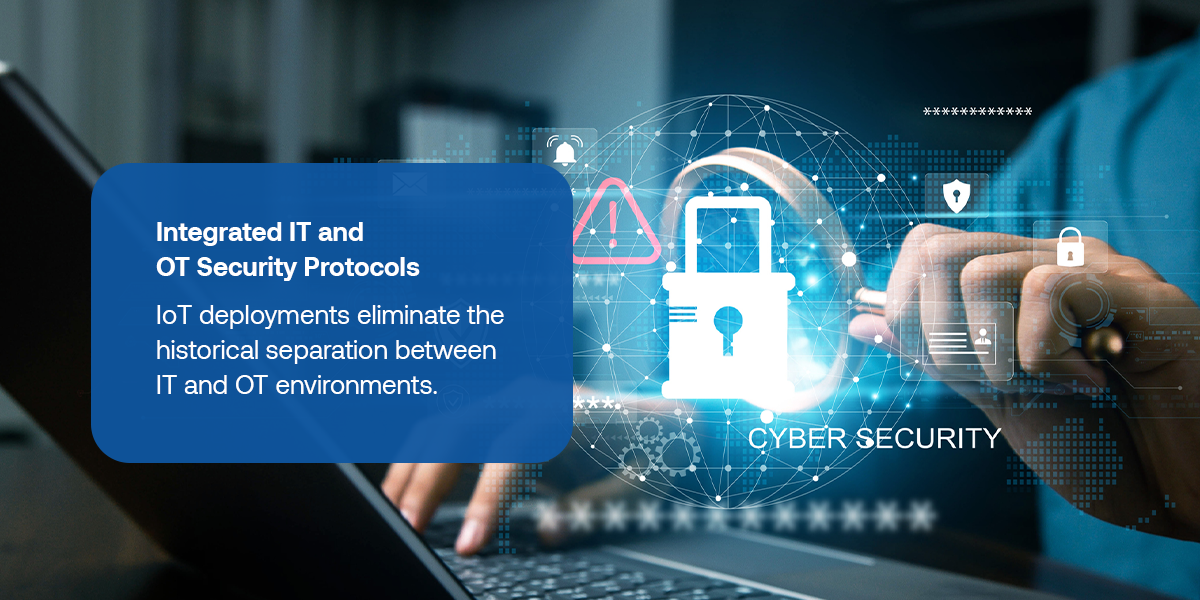
4. Integrated IT and OT Security Protocols
IoT deployments eliminate the historical separation between IT and OT environments. Smart sensors transmit data to cloud platforms. Technicians access OT controls via IT networks, and remote monitoring capabilities continuously bridge both domains.
This convergence creates security gaps when teams operate independently. IT security policies might require password rotation that conflicts with OT system limitations, while firewall rules designed for office networks can block time-sensitive control signals.
Integrated security protocols require collaboration between IT and OT stakeholders from the planning stage forward. Joint risk assessments identify where vulnerabilities span both domains. The EPA’s cybersecurity resources include planning frameworks that cover both environments.
The Operational Benefits of a Secure-by-Design IoT Strategy
A well-architected security framework delivers benefits that extend beyond threat prevention to improved operations and reduced costs.
Enhancing Operational Efficiency and Reducing Downtime
Secure, reliable IoT infrastructure provides superior operational visibility, translating into concrete improvements.
- Predictive maintenance: Addressing wear patterns before failures occur eliminates emergency repairs.
- Resource optimization: Precise chemical dosing becomes possible while energy consumption analysis identifies inefficient operations.
- Leak detection: Flow monitoring reduces water loss and treatment costs.
- Remote diagnostics: Reliable remote equipment monitoring minimizes costly truck rolls, letting technicians resolve issues remotely.
Reducing downtime generates value. Every minute critical equipment stays offline represents lost productivity, compliance violations and service interruptions.
Ensuring Data Integrity for Regulatory Compliance and Reporting
A secure end-to-end system means data remains accurate, consistent and tamperproof. This integrity is essential for meeting EPA reporting requirements and demonstrating compliance during audits.
- Auditable records: Timestamped logs document who accessed information and when.
- Automated data collection: Transcription errors that plague manual processes disappear.
- Access controls: Post-hoc modifications that could raise regulatory questions are no longer possible.
IoT security in water quality management protects the testing and monitoring processes that ensure safe drinking water. Smart sensors measuring pH, turbidity and disinfectant residuals form the foundation of this assurance, which is why their readings must be trustworthy. Compromised sensors could report false data that masks actual quality issues or triggers unnecessary treatment adjustments, undermining public safety and operational efficiency.
Creating a Scalable Platform for Future Growth and Innovation
Security architecture built on solid foundations accommodates expansion without requiring a complete redesign. As facilities add monitoring points or integrate new technologies, a well-designed IoT ecosystem scales to meet demands. Each new sensor connects through established security protocols.
Water solutions that integrate IoT security into water quality tools, along with facility-specific workflows, enhance security, provide support and enable operational needs. As facilities scale their IoT deployments, modem security becomes increasingly critical to maintaining the integrity of that foundation. This positions facilities to adopt emerging technologies, like advanced analytics and machine learning, with confidence that their connectivity layer remains secure.
Implementing Your Secure Water Management Ecosystem With AquaPhoenix Scientific
Secure-by-design IoT security in water quality management is foundational to operational success for water facilities. A comprehensive strategy delivers efficiency gains, regulatory confidence and a scalable platform for innovation.
AquaPhoenix Scientific helps water treatment facilities strengthen their infrastructure through three critical areas. Flight managed modems provide secure, monitored connectivity between remote sites and your central systems. Aliquot software centralizes water quality data and compliance documentation in tamperproof audit trails. Finally, our test kits and reagents verify that the water-quality data your IoT sensors report match actual field conditions.
When you secure your connectivity layer, protect your data integrity and verify your results with trusted testing products, you build confidence that your IoT ecosystem works as intended. Our team supports water facilities with technical guidance specific to treatment operations, rather than generic IT solutions.
Contact AquaPhoenix Scientific to discuss how Flight, Aliquot and our test kits can strengthen your water management infrastructure.